Contact Us

In pharmaceutical and life sciences industries, stability testing is essential for ensuring products remain safe, effective, and compliant throughout their shelf life. As testing requirements grow and product portfolios become more complex, companies are increasingly evaluating the best controlled environment solutions for their operations. One of the most important comparisons is reach-in vs walk-in environmental rooms.
Both solutions are designed to maintain precise temperature and humidity conditions for stability testing and controlled storage. However, they differ significantly in terms of capacity, scalability, flexibility, and operational efficiency. Choosing the right option depends on your current testing volumes, available space, future growth plans, and the complexity of your product pipeline.
What are Reach-in Environmental Rooms?
Reach-in environmental rooms, are compact-controlled environmental units designed for smaller scale stability testing and storage applications. These systems provide tightly regulated temperature and humidity conditions while occupying a relatively small footprint within a laboratory or production environment.
Reach-in systems are commonly used for:
- Research and development
- Small-scale stability studies
- Quality control applications
- Product testing
One of the key features of reach-in systems is their convenience. They feature a significantly smaller footprint compared to walk-in systems while offering less investment costs for businesses.
For businesses with lower testing volume requirements or limited space, LTE offer reach-in environmental rooms custom built to your every need.
What are Walk-in Environmental Rooms?
Walk-in environmental rooms are large-scale controlled environments specifically designed for high-volume stability testing and storage. Unlike reach-in systems, walk-in rooms allow personnel to physically enter the controlled space to access samples, shelving systems, and storage areas.
Walk-in environmental rooms are ideal for:
- Large scale stability testing
- Long-term storage programmes
- High-volume product testing
Because walk-in rooms are custom-built, they can be tailored to meet specific operational requirements, including shelving layouts, monitoring systems, access configurations, and environmental conditions.
Reach-in vs Walk-in Environmental Rooms: Key Differences
Although both systems provide controlled environmental conditions, there are several major differences between reach-in and walk-in environmental rooms.
- Capacity– reach-in systems are designed for smaller sample sizes with easy access to samples while walk-in systems are designed to accommodate significantly larger inventories
- Flexibility– reach-in units feature fixed internal configures with limited adaptability, whereas walk-in rooms provides customisation on shelving systems, room layouts and storage configurations.
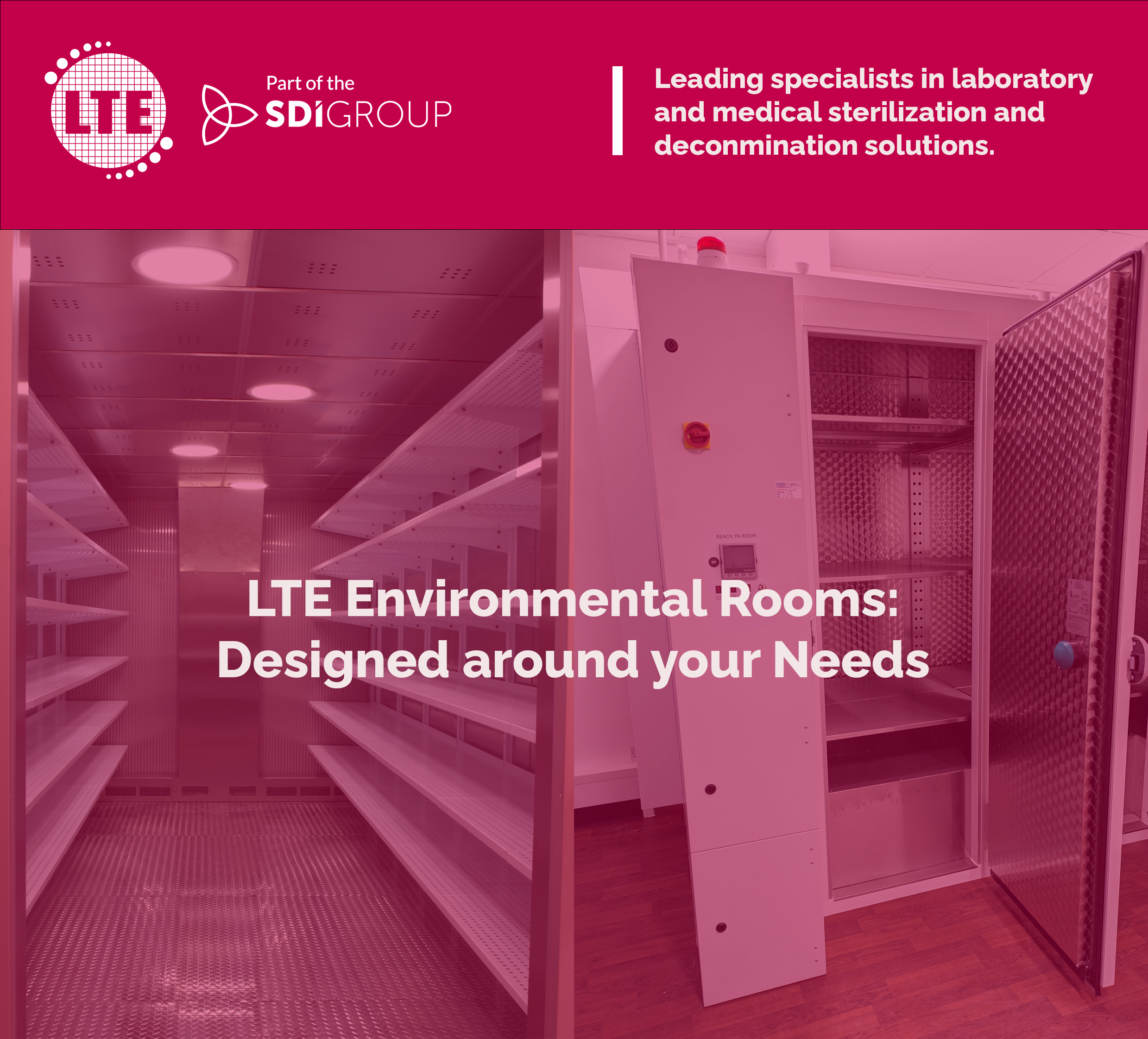
LTE Environmental Rooms:
At LTE, we provide state-of-the-art reach-in and walk-in environmental rooms designed for precise and reliable stability testing. Our solutions are tailored to meet the demanding requirements of pharmaceutical and biotech industries.
Our environmental rooms are suitable for all ICH Zone II drug stability tests – long term, intermediate and accelerated conditions. Standard operating parameters range from -20°C to +45°C and 20-90% RH +5%. Rooms operating at +5°C and below will typically have a temperature tolerance of ±3°C.
All environmental rooms are custom built, depending on the requirements of the customer, ensuring every specification is to the customers every need
As per the ICH conditions, the rooms must be kept to precise temperature and humidity for the testing to be correct. If the temperature drops 5°C above or below the amount required, an alarm goes off. LTE provides a PID control system ensures that the temperature and environmental conditions are always at the right conditions.
Our reach-in and walk-in rooms are manufactured from self-supporting modular insulated panels, which are 80mm or 100mm thick depending on size, room operating temperature and room location. Panels are injected with a CFC-free polyurethane foam as standard. Alternatively, where site conditions demand, panels can be Polyisocyanurate injected, making them LPC & FM Approved. Our standard finish is a white food safe epoxy coating, however a stainless steel internal finish is also available.
Future-Proof Your Stability Testing Infrastructure
As pharmaceutical and life sciences operations continue to evolve, environmental control systems must be capable of supporting increasing testing complexity and higher storage volumes. While reach-in environmental rooms remain effective for smaller applications, walk-in environmental rooms provide the scalability, flexibility, and efficiency required for larger-scale stability testing programmes.
LTE Scientific specialises in the design and manufacture of high-performance walk-in environmental rooms tailored to pharmaceutical and life sciences applications. Whether you are expanding biologics capabilities, increasing testing capacity, or upgrading existing infrastructure, LTE Scientific can help deliver a bespoke controlled environment solution built around your operational needs.